I recently purchased an acrylic landscape painting at the Minnehaha Falls Art Fair for $1200. It’s an impressionistic rendering of a mountain and stream in Denali National Park by A.D. Hogan. I have yet to visit Alaska but it’s a destination high on my bucket list. Minnesota is long on lily pads and lacking in mountains. Perhaps the painting will inspire me to make the journey. I worried I would regret the purchase, but I remain quite happy with it. The vibrant blue and yellow brushstrokes complement the décor of my apartment wonderfully. I like to surround myself with beauty whenever possible.
My intention in mentioning the price of the painting was not to brag. Rather to ask the question: what is art worth? Is art a necessity? I would say so, but you don’t have to pay for it. Art, like nature, is all around us. In April, I hiked with my sons from Minnehaha Falls to the Mississippi River. Along the creek, a stretch of boardwalk had been washed away by flood. Rebellious and adventure-seeking, we paid the trail-closed sign little heed except to admire the graffiti emblazoned on it.
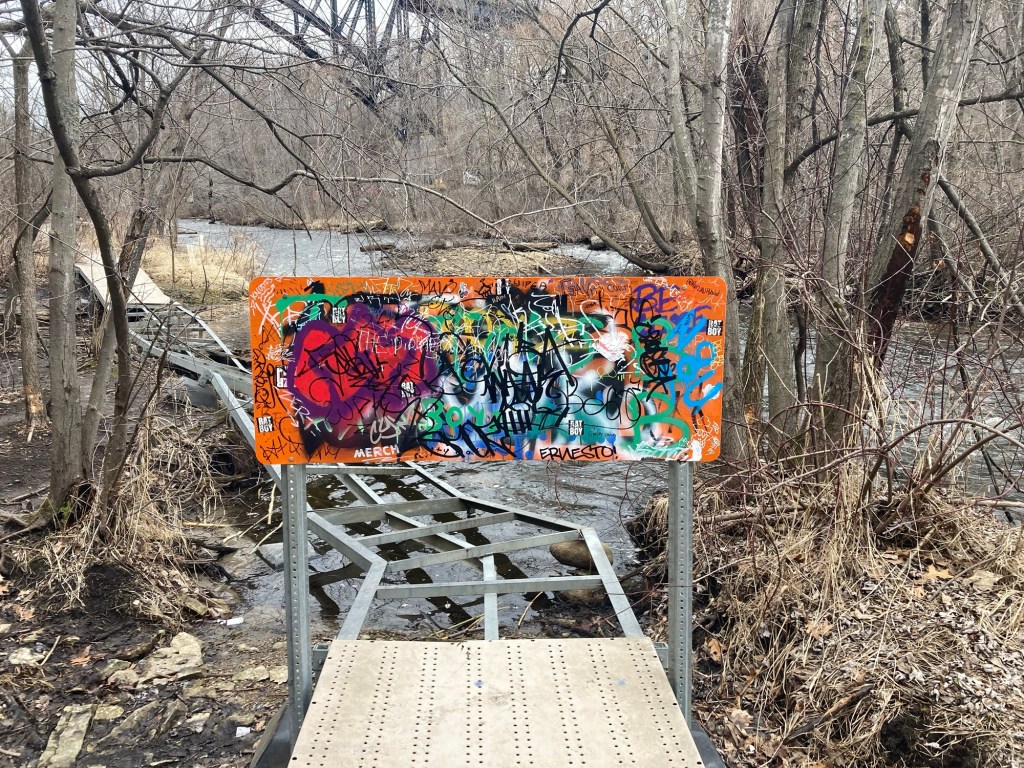
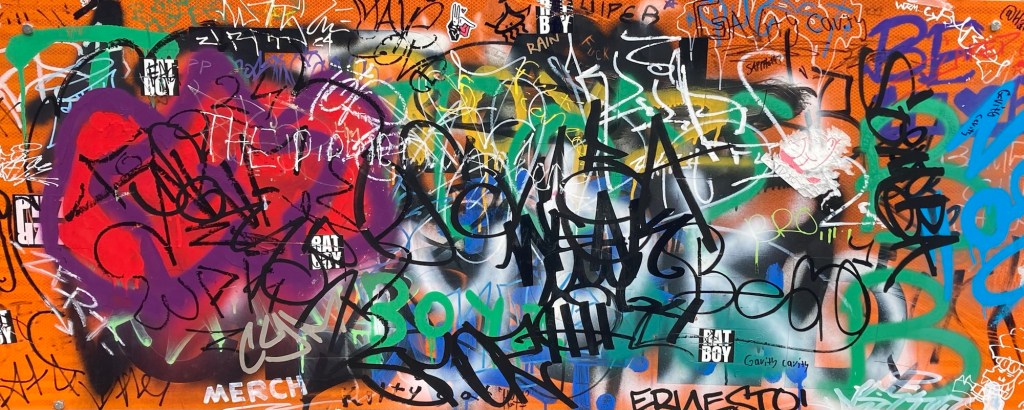
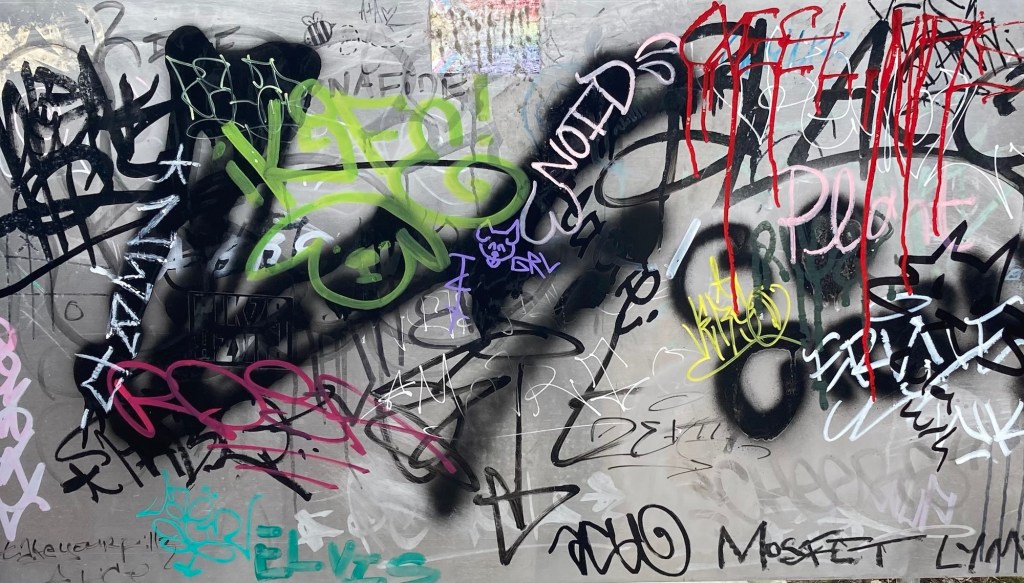
Long time readers of my blog know I am somewhat obsessed with graffiti.

I shared photographs of both the front and back of the vandalized sign. In retrospect, I wish I had stolen it because I love the images. Collectively, I believe the juvenile delinquents who passed this way created works of abstract expressionism equaled by very few art school graduates. Obviously, art appraisal is subjective and I only took one art history class in college. Personally though, I think this double-sided work of accidental art is every bit as good as the $1200 canvas on my wall. This is not meant as any slight to A.D. Hogan, a husband-and-wife team of artists based in Eau Claire, WI.
No genre of visual art is as divisive as abstract expressionism. Admittedly, I prefer pretty pictures that look like something. My father, along with many others, called Jackson Pollock a “mud slinger.” I’ve seen Pollock’s work in person and I think it’s fantastic. It’s nothing to argue about because no one is right. I do believe that the freedom and energy achieved by Pollock’s layered drip technique has much in common with the spray-can art I photographed.
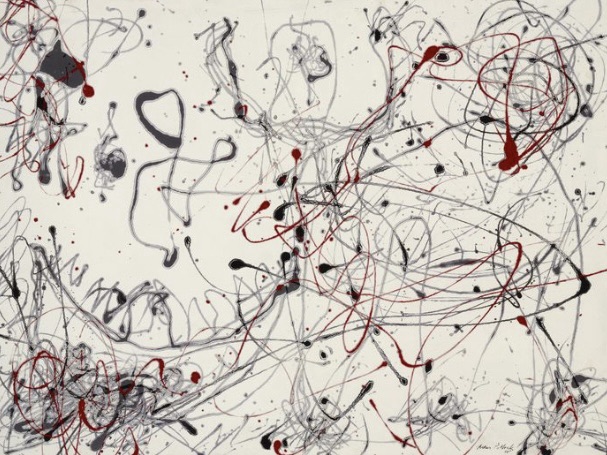
A friend of mine with a degree in Art History recommended Clyfford Still to me. His paintings have sold for as much as $114 million. I tried to be diplomatic about my answer, but I saw no merit in his work whatsoever. “Worth every penny,” he told me.
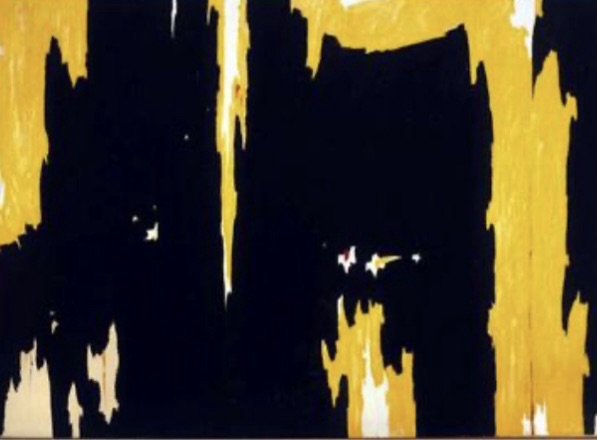
You be the judge. I remain fucking baffled. If one sucker pays that much for something, I guess that’s what it’s worth. There is a lot of money laundering and tax evasion in the art world. Like I said, I’m no expert. I grew up in a trailer home and our walls were decorated with cross-stitch pictures.
A professional art collector lives on my postal route. He has a climate-controlled warehouse space nearby where he stores paintings for people. Each canvas is protectively cased and the paintings are shelved and organized numerically. There’s not a scrap of decoration in the place, not even a calendar. They may as well be car parts or Ikea furniture. Their owners probably have as much emotional attachment to them as I do the Coca-Cola stock in my 401K. I don’t think much of this. Art is for looking at. I assume the children of the owners are waiting for them to die so they can sell them and pay off their mortgages.
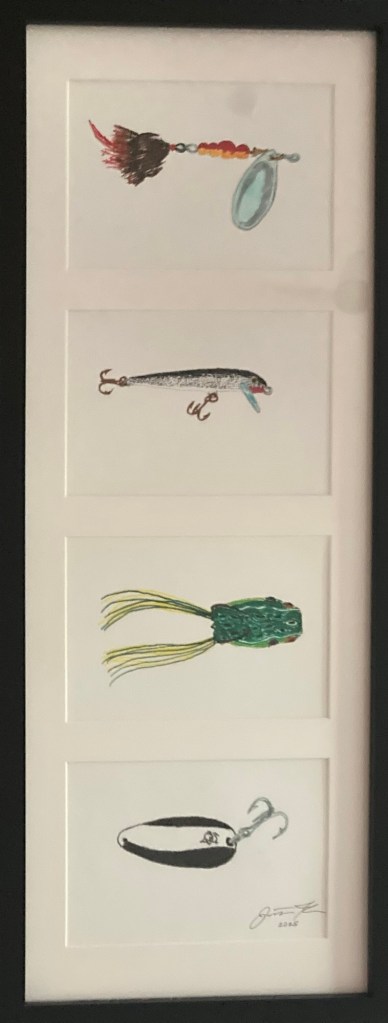
Recently, I’ve been playing around with the markers myself. I enjoy drawing in the mornings. If the subject matter is simple enough, the results are not terrible. “Charming” is the word I would use to describe my own work. I would not be offended if your word is less charitable. I’m no Clyfford Still. Pictured below is a collection of my fishing lure sketches. I estimate their worth at $35 which is what I paid for the frame.
 Crow City